




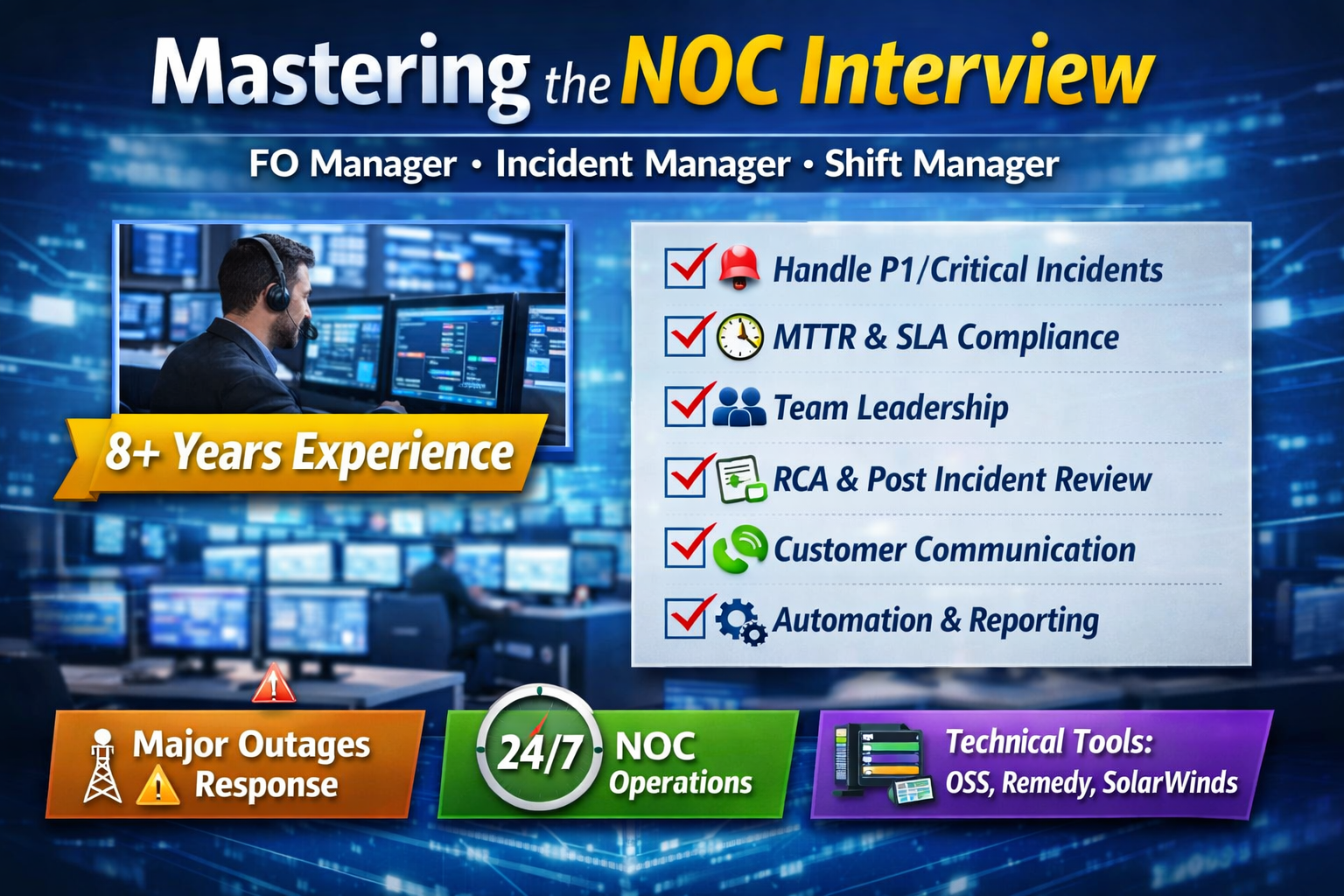
1️⃣ Introduction
Recruiter:
Good morning. Thank you for joining today. Please briefly introduce yourself and share your experience related to NOC operations and incident management.
Candidate:
Thank you for the opportunity. I have over 8 years of experience in Telecom NOC operations, with 3 years as Incident Manager. I’ve handled multi-technology environments including Core, RAN, Transmission, IP, and enterprise services. My focus has been on SLA management, escalation handling, major incident coordination, and stakeholder communication.
2️⃣ NOC Operations Experience
Recruiter:
What is your understanding of a Front Office Manager’s role?
Candidate:
A Front Office Manager is responsible for real-time monitoring, incident handling, SLA compliance, escalation management, and customer communication. The role ensures quick detection, proper ticketing, coordination with Back Office/Field teams, and timely restoration of services.
Recruiter:
What KPIs do you monitor in NOC – FO operations?
Candidate:
Key KPIs include:
- MTTR (Mean Time to Restore)
- MTTA (Mean Time to Acknowledge)
- SLA compliance percentage
- Incident backlog
- Repeat incidents
- First-time resolution rate
- Escalation frequency
3️⃣ Incident Management (Major Focus)
Recruiter:
How do you handle a P1 / Critical Incident?
Candidate:
My structured approach:
- Immediate acknowledgment & ticket creation
- Bridge call initiation within 5–10 minutes
- Stakeholder notification (internal & customer)
- Assign technical owner (RCA responsible)
- Real-time tracking until resolution
- Post-incident review & RCA documentation
Recruiter:
How do you ensure SLA compliance?
Candidate:
- Real-time monitoring dashboard
- Automated escalation matrix
- Shift-wise performance review
- Daily SLA tracking report
- Proactive follow-up before breach
4️⃣ Leadership & Team Handling
Recruiter:
How do you manage shift teams in a 24/7 NOC environment?
Candidate:
- Clear shift handover process
- Defined RACI matrix
- Weekly performance review
- Training for new technologies
- Motivation and recognition programs
Recruiter:
How do you deal with underperforming team members?
Candidate:
- 1-on-1 discussion
- Root cause analysis (skill gap vs attitude)
- Targeted improvement plan
- Monitoring progress
- Escalation to management only if required
5️⃣ Technical Scenario-Based Questions
Recruiter:
Suppose there is a nationwide outage affecting 40% of network traffic. What will you do?
Candidate:
- Declare Major Incident
- Inform leadership immediately
- Open bridge call
- Engage Core, Transmission, Power teams
- Continuous customer update every 30 minutes
- Assign RCA owner
- Share preliminary report within 2 hours
Recruiter:
What tools have you worked with?
Candidate:
Examples:
- OSS tools (NetAct, U2000, MantaRay etc.)
- Ticketing systems (Remedy, ServiceNow)
- Monitoring tools (SolarWinds, Zabbix)
- Reporting dashboards (Power BI / Excel automation)
6️⃣ Customer Communication
Recruiter:
How do you handle an angry enterprise customer during outage?
Candidate:
- Stay calm and professional
- Acknowledge the impact
- Share clear technical status
- Provide realistic ETA
- Follow-up until closure
7️⃣ Reporting & Automation
Recruiter:
How can automation improve NOC efficiency?
Candidate:
- Automated alarm correlation
- SLA breach alerts
- Auto-ticket creation
- Dashboard-based reporting
- AI-based predictive alerts
8️⃣ Closing Questions
Recruiter:
Why should we hire you for this position?
Candidate:
I bring strong incident leadership, SLA-driven mindset, telecom technical knowledge, and customer-facing experience. I can manage high-pressure situations and ensure operational excellence in 24/7 environments.
Leave a Reply